
The bill is back. Here's what you need to know.

Updated: Jul 29
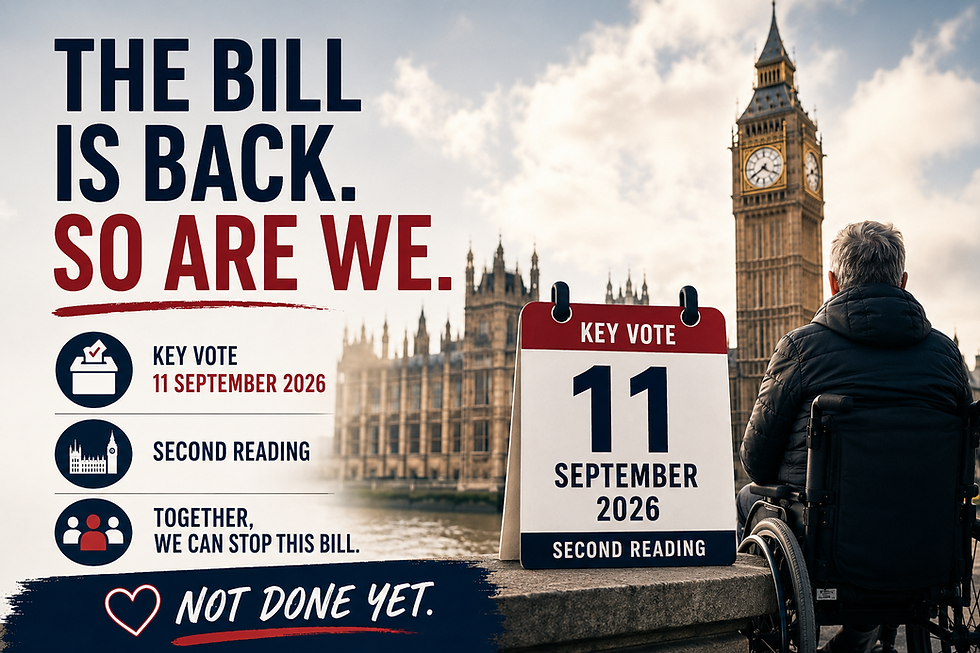
On 17 June, Labour MP Lauren Edwards introduced a new assisted dying bill in the House of Commons. The second reading debate — when MPs vote on whether the bill should proceed — is set for 11 September 2026.
You may feel you've heard all this before. You have. This is, in almost every meaningful way, the same Terminally Ill Adults (End of Life) Bill that Kim Leadbeater first brought forward in 2024.
The bill was scrutinised more heavily than any private member's bill in parliamentary history. It generated over 1,300 amendments in the House of Lords — more than War and Peace has pages.
It's the one that fell in April when Parliament was prorogued, not because it was rejected, but because time ran out.
So what's actually changed?
Two minor amendments from the Lords have been incorporated into the new bill.
The Wales amendment is a technical, devolution-related change. Because delivering healthcare is a matter for the Welsh Government rather than Westminster, the new bill requires the Senedd — the Welsh Parliament — to give its consent before Welsh Ministers can create the regulations needed to implement assisted dying in Wales. It's essentially a constitutional tidying-up. It doesn't change the substance of what the bill proposes.
The eating disorder amendment is more troubling — and more revealing about the bill's continued flaws. During the Lords committee stage earlier this year, peers raised serious concerns about people with conditions like anorexia who might stop eating to bring themselves within the bill's six-month terminal prognosis threshold. In other words, a person with anorexia could, in theory, deliberately starve themselves to qualify for an assisted death.
The Lords explored a compromise on this, and a minor amendment was included. But experts and campaigners — including eating disorder charities and disability organisations — have warned that this amendment does not close the loophole. The bill still does not explicitly prevent this from happening.
Both amendments are minor. Neither addresses the fundamental problems we have always identified: a social care system in crisis, palliative care that is chronically underfunded, and disabled and seriously ill people who too often feel like a burden rather than valued members of society. In that context, a "choice" to die is no choice at all.
Even the new Prime Minister, Andy Burnham, has said he would vote for the principle of assisted dying — but added a significant caveat. "There should be a kind of requirement that the hospices of this country get properly funded and sorted out before that law change comes in," he said. "You can't have this law change with an underfunded hospice movement." We couldn't agree more. That underfunding hasn't been fixed. The condition hasn't been met.
What happens next?
We are meeting very soon to finalise our campaign strategy for September. Our focus will be on persuading MPs to vote against the bill at second reading on the 11th — and we are also planning a demonstration outside the Houses of Parliament on 11 September.
We will share details of both as soon as they are confirmed. We will make it as easy as possible to get involved, whether you can be there in person or want to support from home.
The stakes are high. September will come quickly. We'll be in touch very soon.